



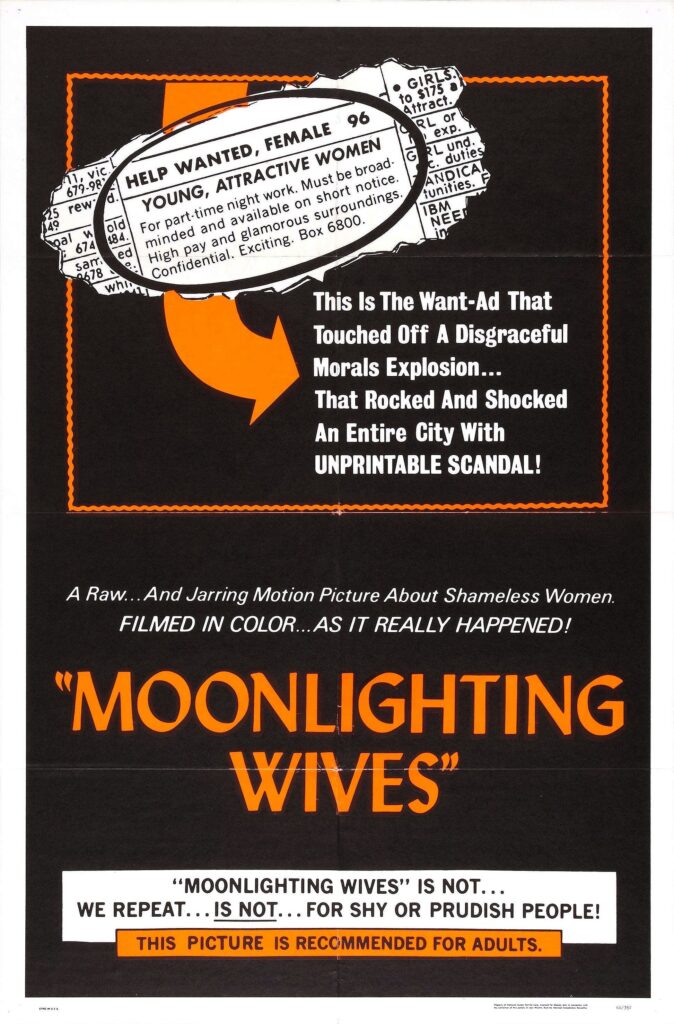
Released in 1966, Moonlighting Wives is a bold American drama that quietly pulls back the curtain on suburban life, revealing the emotional restlessness hidden beneath neat lawns and polite smiles. At a time when cinema rarely spoke openly about loneliness, desire, and dissatisfaction within marriage, this film dared to explore what happens when women feel unseen in their own homes. Rather than relying on shock value alone, Moonlighting Wives uses intimacy as a storytelling tool—one that reflects deeper emotional voids and unspoken frustrations.
Movie Overview
Title
Moonlighting Wives
Release Year
1966
Director
Joseph P. Mawra
Runtime
Approx. 70 Minutes
Language
English
Genre
Drama, Exploitation
Country
United States
Age Rating
Not Rated
| Title | Moonlighting Wives |
|---|---|
| Release Year | 1966 |
| Director | Joseph P. Mawra |
| Runtime | Approx. 70 Minutes |
| Language | English |
| Genre | Drama, Exploitation |
| Country | United States |
| Age Rating | Not Rated |
Movie Cast
Actor
Role
Ann Perry
One of the suburban wives
June Roberts
Married woman from the neighborhood
Mary Mendum
Housewife struggling with loneliness
Joe Rossi
Supporting male character
| Actor | Role |
|---|---|
| Ann Perry | One of the suburban wives |
| June Roberts | Married woman from the neighborhood |
| Mary Mendum | Housewife struggling with loneliness |
| Joe Rossi | Supporting male character |
Storyline
Moonlighting Wives (1966) is a provocative suburban drama that peers beneath the polished surface of middle-class married life. Set in a quiet American neighborhood, the film follows a group of housewives who appear content on the outside but are quietly suffocating under emotional neglect, routine, and unfulfilled desires.
While their husbands remain absorbed in work and social status, the women spend their days trapped in isolation, maintaining appearances and suppressing their emotional needs. As boredom and loneliness grow, secret encounters and forbidden relationships begin to form—offering brief moments of excitement, validation, and escape from their monotonous lives.
What starts as curiosity soon turns into risky double lives, as the women struggle to balance desire with guilt and fear of exposure. Behind closed doors, passion clashes with social expectations, revealing the fragile foundations of marriages built more on obligation than connection.
Rather than judging its characters, Moonlighting Wives presents their actions as a response to emotional absence and societal pressure. The film unfolds as a slow-burn exploration of temptation, hypocrisy, and the quiet rebellion of women seeking to feel seen and alive—making it a daring and reflective piece of 1960s cinema.
Movie Summary & Key Moments
Key Moment
Description
Perfect Lives on the Surface
The film opens in a peaceful suburban neighborhood where married women appear content and well-settled. Beneath the calm exterior, however, emotional dissatisfaction and routine dominate their daily lives.
Emotionally Absent Marriages
As the story unfolds, it becomes clear that many husbands are distant, preoccupied with work and status, leaving their wives starved for attention, affection, and genuine companionship.
The Search for Validation
Loneliness pushes the women to seek emotional and physical connection outside their marriages. These secret encounters offer excitement and validation missing from their everyday lives.
Living Double Lives
The wives begin leading hidden lives, carefully balancing desire with fear of exposure. Guilt and excitement exist side by side as societal expectations loom over every decision.
Rising Tension and Suspicion
As secrecy becomes harder to maintain, tension builds within marriages and the community. Small gestures and subtle changes hint that the truth may soon surface.
A Stark Reality Check
The film concludes without easy answers, highlighting the emotional cost of neglect, hypocrisy, and unspoken desires. Moonlighting Wives ends as a reflective commentary on marriage, morality, and suppressed longing.
| Key Moment | Description |
|---|---|
| Perfect Lives on the Surface | The film opens in a peaceful suburban neighborhood where married women appear content and well-settled. Beneath the calm exterior, however, emotional dissatisfaction and routine dominate their daily lives. |
| Emotionally Absent Marriages | As the story unfolds, it becomes clear that many husbands are distant, preoccupied with work and status, leaving their wives starved for attention, affection, and genuine companionship. |
| The Search for Validation | Loneliness pushes the women to seek emotional and physical connection outside their marriages. These secret encounters offer excitement and validation missing from their everyday lives. |
| Living Double Lives | The wives begin leading hidden lives, carefully balancing desire with fear of exposure. Guilt and excitement exist side by side as societal expectations loom over every decision. |
| Rising Tension and Suspicion | As secrecy becomes harder to maintain, tension builds within marriages and the community. Small gestures and subtle changes hint that the truth may soon surface. |
| A Stark Reality Check | The film concludes without easy answers, highlighting the emotional cost of neglect, hypocrisy, and unspoken desires. Moonlighting Wives ends as a reflective commentary on marriage, morality, and suppressed longing. |
IMDB Rating - 5.6/10
Where To Watch
Coming Soon
Streaming platform information will be updated once available
Note: The movie is not yet available for streaming. Availability will be updated once it is released on digital platforms.
Facts & Trivia
- Title: Moonlighting Wives (1966) is an American exploitation-era drama that examines suburban marriage and suppressed desire.
- Director: The film was directed by Joseph P. Mawra, a filmmaker known for provocative low-budget films of the 1960s.
- Release Year: The movie was released in 1966, during a period when independent cinema was pushing boundaries ahead of the Hollywood mainstream.
- Genre Classification: Often categorized as Drama and Sexploitation, the film focuses more on social commentary than explicit storytelling.
- Black-and-White Production: Moonlighting Wives was shot in black and white, giving it a stark, documentary-like visual tone.
- Running Time: The film has a relatively short runtime, typical of independent exploitation films from the era.
- Setting: The story is set in a quiet suburban American neighborhood, symbolizing outward respectability and hidden dissatisfaction.
- Core Themes: The movie explores emotional neglect, marital boredom, hypocrisy, secrecy, and the social pressure to maintain appearances.
- Female Perspective: Unlike many films of its time, the story places women’s emotional frustration and inner conflict at the center of the narrative.
- Minimal Dialogue: Much of the film’s tension is conveyed through body language and silence rather than heavy dialogue.
- Censorship Era: Released before the modern film rating system, the movie was distributed without an official MPAA rating.
- Controversial Reception: At the time of release, the film attracted attention for challenging conservative views on marriage and female desire.
- Modern Reassessment: Today, Moonlighting Wives is often discussed as a cultural artifact that reflects shifting social attitudes of the 1960s.
- Exploitation Cinema Legacy: The film is part of a wave of independent movies that paved the way for more open discussions of adult relationships in later decades.
- Historical Value: While modest in scale, the movie remains relevant for viewers interested in classic exploitation cinema and early feminist subtext.
- Title: Moonlighting Wives (1966) is an American exploitation-era drama that examines suburban marriage and suppressed desire.
- Director: The film was directed by Joseph P. Mawra, a filmmaker known for provocative low-budget films of the 1960s.
- Release Year: The movie was released in 1966, during a period when independent cinema was pushing boundaries ahead of the Hollywood mainstream.
- Genre Classification: Often categorized as Drama and Sexploitation, the film focuses more on social commentary than explicit storytelling.
- Black-and-White Production: Moonlighting Wives was shot in black and white, giving it a stark, documentary-like visual tone.
- Running Time: The film has a relatively short runtime, typical of independent exploitation films from the era.
- Setting: The story is set in a quiet suburban American neighborhood, symbolizing outward respectability and hidden dissatisfaction.
- Core Themes: The movie explores emotional neglect, marital boredom, hypocrisy, secrecy, and the social pressure to maintain appearances.
- Female Perspective: Unlike many films of its time, the story places women’s emotional frustration and inner conflict at the center of the narrative.
- Minimal Dialogue: Much of the film’s tension is conveyed through body language and silence rather than heavy dialogue.
- Censorship Era: Released before the modern film rating system, the movie was distributed without an official MPAA rating.
- Controversial Reception: At the time of release, the film attracted attention for challenging conservative views on marriage and female desire.
- Modern Reassessment: Today, Moonlighting Wives is often discussed as a cultural artifact that reflects shifting social attitudes of the 1960s.
- Exploitation Cinema Legacy: The film is part of a wave of independent movies that paved the way for more open discussions of adult relationships in later decades.
- Historical Value: While modest in scale, the movie remains relevant for viewers interested in classic exploitation cinema and early feminist subtext.
FAQs About Moonlighting Wives (1966)
1. What is Moonlighting Wives (1966) about?
Moonlighting Wives is a suburban drama that explores emotional neglect and hidden desires among married women. The film looks beneath the surface of respectable marriages to reveal loneliness, secrecy, and social hypocrisy.
2. Who directed Moonlighting Wives?
The film was directed by Joseph P. Mawra, known for making provocative independent films during the 1960s exploitation cinema era.
3. Is Moonlighting Wives based on a true story?
No. The movie is a fictional narrative, but its themes are grounded in real social dynamics and marital realities of mid-20th-century suburban life.
4. What genre does Moonlighting Wives belong to?
The film is commonly classified as a drama and sexploitation film, focusing more on social commentary and emotional tension than explicit content.
5. Is Moonlighting Wives suitable for all audiences?
Due to mature themes related to marriage, desire, and infidelity, the film is intended for adult viewers. It was released before the modern MPAA rating system.
6. Where can I watch Moonlighting Wives (1966)?
Availability may vary by region. The film can sometimes be found through classic cinema distributors, archival releases, or specialty streaming platforms focused on vintage films.
1. What is Moonlighting Wives (1966) about?
Moonlighting Wives is a suburban drama that explores emotional neglect and hidden desires among married women. The film looks beneath the surface of respectable marriages to reveal loneliness, secrecy, and social hypocrisy.
2. Who directed Moonlighting Wives?
The film was directed by Joseph P. Mawra, known for making provocative independent films during the 1960s exploitation cinema era.
3. Is Moonlighting Wives based on a true story?
No. The movie is a fictional narrative, but its themes are grounded in real social dynamics and marital realities of mid-20th-century suburban life.
4. What genre does Moonlighting Wives belong to?
The film is commonly classified as a drama and sexploitation film, focusing more on social commentary and emotional tension than explicit content.
5. Is Moonlighting Wives suitable for all audiences?
Due to mature themes related to marriage, desire, and infidelity, the film is intended for adult viewers. It was released before the modern MPAA rating system.
6. Where can I watch Moonlighting Wives (1966)?
Availability may vary by region. The film can sometimes be found through classic cinema distributors, archival releases, or specialty streaming platforms focused on vintage films.
Similar Movies Like Moonlighting Wives (1966)
- The Wife Swappers (1970) – A controversial exploitation-era film examining suburban boredom, desire, and marital experimentation.
- I, A Woman (1965) – A European drama focused on female desire, emotional dissatisfaction, and social rebellion.
- Score (1974) – A cult classic exploring sexual liberation, relationship boundaries, and emotional manipulation.
- The Graduate (1967) – A mainstream classic that subtly reflects generational disconnect, loneliness, and forbidden attraction.
- Bob & Carol & Ted & Alice (1969) – A satirical look at modern marriage, honesty, and shifting sexual values.
- Reflections in a Golden Eye (1967) – A psychological drama dealing with repression, desire, and emotional isolation.
- The Wife Swappers (1970) – A controversial exploitation-era film examining suburban boredom, desire, and marital experimentation.
- I, A Woman (1965) – A European drama focused on female desire, emotional dissatisfaction, and social rebellion.
- Score (1974) – A cult classic exploring sexual liberation, relationship boundaries, and emotional manipulation.
- The Graduate (1967) – A mainstream classic that subtly reflects generational disconnect, loneliness, and forbidden attraction.
- Bob & Carol & Ted & Alice (1969) – A satirical look at modern marriage, honesty, and shifting sexual values.
- Reflections in a Golden Eye (1967) – A psychological drama dealing with repression, desire, and emotional isolation.